What Bears, Brains and Algorithms Have in Common
Written by: Kurt Schliemann5 min read

Updated: 09/25/26
On this page
It was 2 a.m. and I was startled awake.
A bang, from downstairs.
My kids were too little to be up at this hour and also too little to make a noise like that.
I jumped out of bed, trembling.
Walking downstairs in my underwear, I heard it again. It sounded like it was coming from the garage. And I knew instantly what it was.
As I approached the door to the garage, another bang. I was afraid to open it, but I knew I didn’t have a choice.
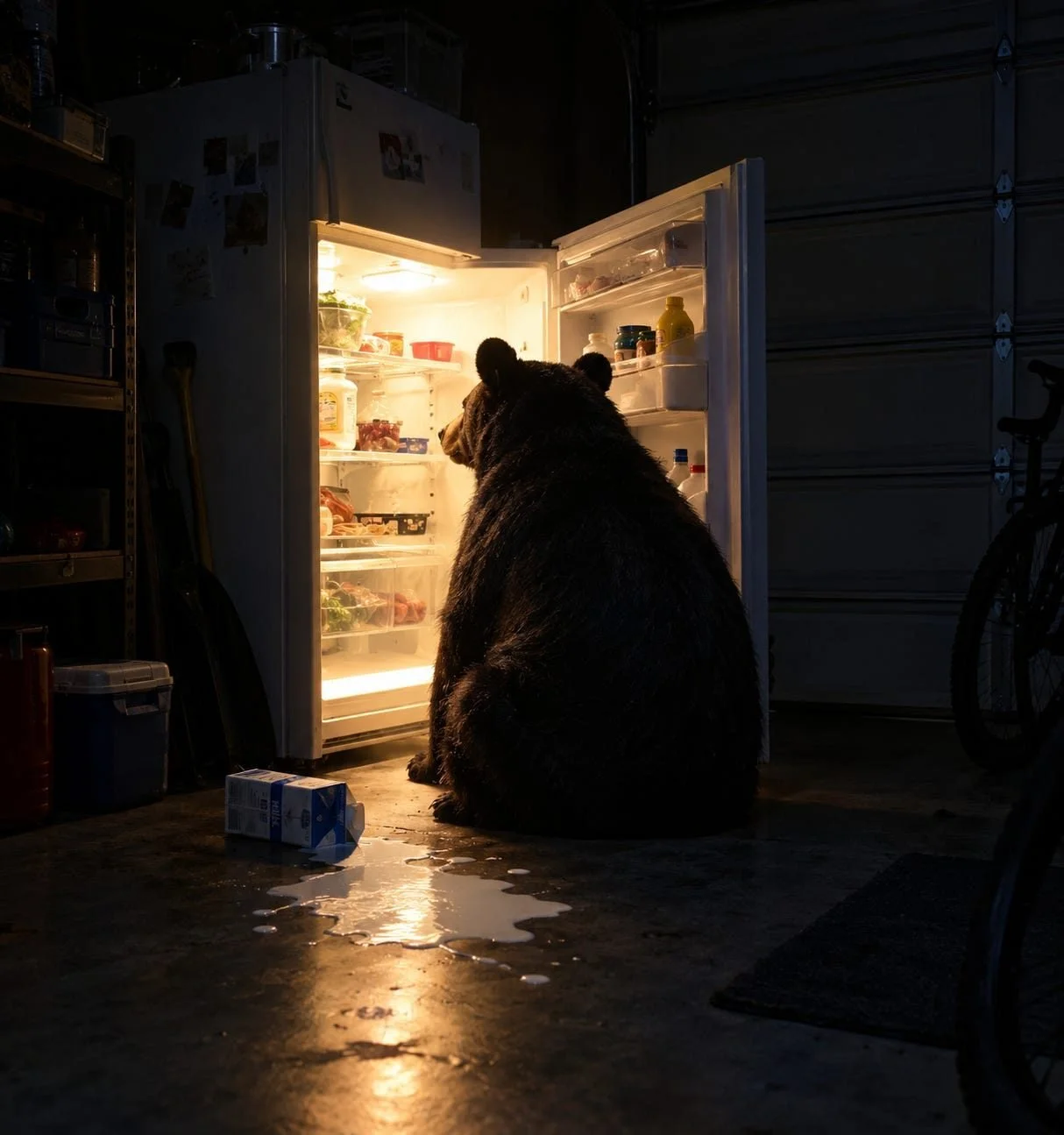
Slowly, I creaked the door open. The first thing I noticed was the shining light of our refrigerator, illuminating an otherwise black space.
As my eyes adjusted, I saw movement on the other side of my car. A black bear, typical for Lake Tahoe, was working through some frozen salmon. He was enjoying it with a side of milk, a carton of which lay on the garage floor next to him, dribbling all over like a Jackson Pollock.
I turned the garage light on, which temporarily moved his attention away from the fish. We stared at each other. My mind raced. I could afford to be bold -- my car stood between me and the bear. On the other side of my car was the access point: an open door that led to our front yard. Wide open.
I began to yell and shout. I attempted to look as big as I could in my boxers (thankfully there is no known video of this encounter). I intellectually knew that black bears rarely attack humans. My nervous system did not. My heart racing, I picked something up, not heavy. I threw it at him. He looked annoyed, but not angry. I threw something else, shouting louder. By this time, my wife had come downstairs to join me. Seeing two of us, the bear reluctantly turned toward the door and left.
I was frustrated at myself. I knew better than to leave a door to the outside unlocked, in bear country.
And I knew this was just the beginning.
Bears have incredible memories for food sources. They will remember the location of found food for many years afterwards. And the cubs can even learn it by watching their mom.
That bear, and probably its cubs too, would be checking our garage door for a long time to come.
The bears know what they like. And they remember.
We’ve built our society to work like this, too: a world of echo chambers, driven by algorithms that remember what you like, what you click on, even where you linger on a page. And the algorithm gives you more and more, until you give it different information about what you find interesting. And it keeps getting smarter. Just like those bear cubs who can learn where to find food even if they didn’t have the direct experience.
Your brain runs the same loop, and it’s harder to see because it’s inside the frame you’re looking through. The things you notice in the world simply reflect what you already believe; the rest gets filtered out. The life algorithm keeps showing you what you tell your brain to pay attention to -- the things you tell it that matter to you. Your beliefs.
This is how confirmation bias works. In the fall of 1951, Princeton and Dartmouth played a football game so rough it set off a war of editorials in both campus papers. Princeton’s star, playing his last college game, got hurt and couldn’t finish. Two psychologists (one from each school) took the game film and showed it to students from both colleges. They asked them to mark every infraction they saw. Princeton students counted an average of 9.8 by Dartmouth. Dartmouth students, watching the exact same footage, counted 4.3. Who was “right”? The researchers titled their paper “They Saw a Game.“ Each side saw its own version, colored by perception. By belief. And the evidence always agrees. Because you only collect the evidence that agrees.
I work with many people who believe “I’m not good enough.” (I haven’t coached every human on earth -- yet -- but I’d bet we all have this belief in some way, shape, or form). And when the brain has a belief, it works like that bear. It goes looking for proof, finds it, and comes back stronger. More proof, stronger belief, more attention paid to the proof…and on and on. Everywhere they look, the evidence of how “not-good-enough” they are is staring them right in the face.
And when people finally see this truth in themselves, the lightbulb going on is one of my favorite parts of this work. I remember one client, when he finally saw the ways in which his beliefs were driving his perception and his actions -- huge grin, eyes wide, and just, “HOLY SH-T!”
But here’s the best part: you can change the process. Neuroscientist Alvaro Pascual-Leone showed how adaptable our brains are. He had volunteers learn a simple five-finger piano exercise and practice it two hours a day for five days. A second group only imagined playing, for the same length of time. Both groups showed similar changes in the part of the brain that controls finger movement. Where they put their attention changed their brains.
All it takes is a different input. When a new belief is introduced, like “I AM good enough,” the brain begins to find evidence of it. All the ways in which you are really, actually good enough. Slowly, over time, the old belief’s neuropathway weakens. The new one strengthens and takes over. You’re changing the algorithm.
The key is where you’re putting your attention. Many of us aren’t aware of the beliefs that exist under the surface of everything we do. But once we become aware -- we have the ability to make a different choice. Intentionally.
Old beliefs will show up when you least expect them. Locking the door doesn’t make them forget your address. They’ll still show up at 2 a.m. and rattle the handle.
The difference is whether you’ve left the door unlocked.
You might also like
Show all posts